Learn what nano-hydroxyapatite toothpaste can do, what fluoride adds, which amounts are studied, and which claims deserve caution.
Nano-hydroxyapatite toothpaste may help support remineralization of early, non-cavitated enamel lesions (staining, prior to breaking through enamel) and may ease some tooth sensitivity, but it cannot rebuild missing tooth structure or fill a cavity. Some studies of specific formulations report encouraging results, but the overall evidence has limitations; fluoride toothpaste has a longer and broader evidence base for preventing tooth decay.[1][2][8]
If you are comparing labels, the most useful question is not simply whether a paste says “nano.” It is which active ingredients it contains, at what amounts, and whether those exact formulations have been tested. Here is what current research supports—and where marketing can run ahead of it.
Key takeaways
- nHAp is promising, not magic: studies support potential benefits for early mineral loss and dentin sensitivity; it does not regrow a missing piece of enamel or repair a hole in a tooth.
- Fluoride remains the best-established anticaries ingredient: U.S. OTC fluoride toothpastes generally contain 1,000–1,500 ppm fluoride, according to the ADA. [1]
- 10% nHAp is commonly studied, not a universal required or proven-optimal dose: clinical research has used different formulations and concentrations. [3][4]
- Combination research is formulation-specific: a study of fluoride-substituted hydroxyapatite found promising results, but it does not prove that every ordinary nHAp-plus-fluoride paste is synergistic. [5]
- Safety depends on the product and how it is used: a 2025 European opinion covered specified particle shapes and product conditions—not every nanohydroxyapatite material. [6]
What nano-hydroxyapatite is—and what “nano” does not prove
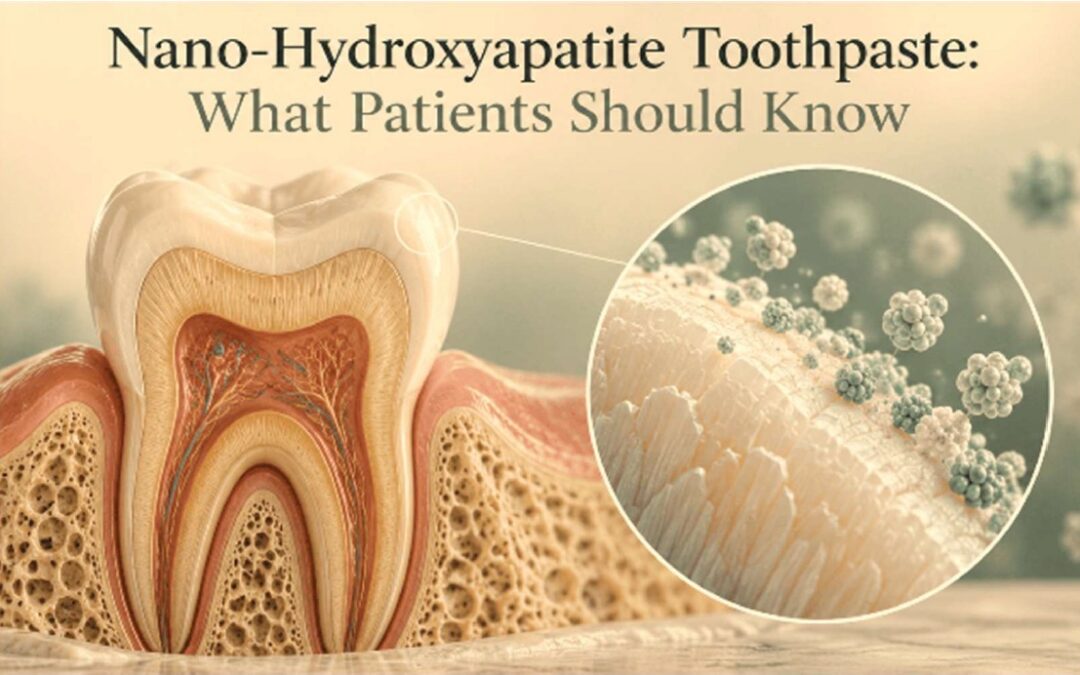
Hydroxyapatite (HAP) is a calcium-phosphate mineral found in teeth and bones. Toothpaste makers use manufactured HAP particles, including nano-sized forms. “Biomimetic” means the material is designed to resemble a mineral found in the body; it does not mean the product is natural, risk-free, or clinically proven to do everything claimed on its packaging. Researchers have proposed a few ways HAP may help in the mouth. Particles can deposit on tooth surfaces and supply calcium and phosphate, which may support repair of early mineral loss. They may also cover exposed dentin tubules—tiny channels that can transmit temperature or touch and contribute to sensitivity. These are plausible mechanisms, and there are laboratory, in-situ, and clinical studies behind them. But evidence for a mechanism is not the same as proof that every toothpaste prevents cavities equally well in everyday use. [2][3]
Think of early enamel damage as a balance: acids from plaque bacteria and acidic foods or drinks can pull minerals from the surface, while saliva and preventive care help return minerals. A toothpaste may support that repair process, but brushing cannot replace missing tooth tissue. Even when remineralization occurs, it may change the mineral state or appearance of an early lesion; it does not recreate the original enamel architecture or make a cavity disappear on demand. The stage of the lesion matters, which is why a dentist’s exam is more informative than a product claim alone. [2]
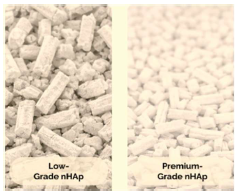
And particle size alone is not a quality grade. The exact particle shape, concentration, surface treatment, other ingredients, and stability of the finished paste may matter. A front-label “nano” claim by itself does not tell you whether the product matches a studied formula. Sensitivity deserves its own evidence check. In an eight-week randomized trial, researchers compared toothpastes with 10% or 15% nHAp, a 10% nHAp formula with 5% potassium nitrate, and a 1,450 ppm fluoride comparator. The study reported reduced sensitivity with the tested HAP formulas, but it was relatively short and sponsored by the HAP toothpaste manufacturer. That supports a possible sensitivity benefit for those products; it does not prove that every concentration or brand will work the same way. [9]
What does the research actually show about nano-hydroxyapatite toothpaste?
It helps to sort studies by what they measured. Laboratory experiments and in-situ studies— where volunteers wear appliances containing enamel samples—can show whether a formula changes mineral loss or gain under controlled conditions. They are useful early evidence, but they do not directly establish how many cavities a person will develop over years.
One 2012 in-situ crossover study tested dentifrices containing 5% and 10% nHAp against a toothpaste with 1,100 ppm fluoride. Thirty adults completed four 28-day study periods while wearing appliances containing enamel specimens. The results supported remineralization effects for the tested pastes, but the design was short and used enamel blocks rather than measuring long-term cavity rates in participants. [3]
A separate 18-month randomized adult trial compared a fluoride-free toothpaste containing 10% hydroxyapatite with a toothpaste containing 1,450 ppm fluoride. In the per-protocol group, 89.3% of participants using HAP and 87.4% using fluoride had no increase in their decayed, missing, and filled tooth-surface score. The researchers designed it as a noninferiority study, using a 20% margin. In plain language, the trial asked whether HAP performed within a pre-set acceptable range of the fluoride control—not whether it was better. The study included generally healthy adults ages 18–45 with at least 10 caries-free molars and premolars, so the results may not transfer directly to someone with frequent decay, dry mouth, untreated cavities, or another high-risk condition. That result is encouraging for the specific HAP formula tested; it is not proof that every nHAp product is equivalent to fluoride for every patient or risk level. The study evaluated hydroxyapatite toothpaste, so it should not automatically be treated as evidence for every product specifically marketed as nano-HAP. [4]
Reviews of the evidence also point to variation in study methods, products, and outcomes, with concerns about study quality and bias in parts of the literature. A 2022 systematic review and meta-analysis, for example, noted substantial limitations in the available clinical study designs. Some studies measure mineral changes in enamel samples; others follow clinical caries outcomes. Those results answer different questions, so a strong laboratory result should not be presented as proof of a specific number of cavities prevented in a patient. In short: nHAp has a real evidence base, but the confidence and breadth of evidence are not identical to those for fluoride. [2][8]
Does fluoride make nano-hydroxyapatite work better?
Possibly in some carefully designed formulas—but a universal “synergy” claim is not established. Fluoride is itself a well-supported anticaries active ingredient. It helps reduce mineral loss during acid attacks and supports remineralization of early lesions. In the United States, the ADA says fluoride toothpastes carrying its Seal for cavity protection must contain fluoride. [1]
There is also a difference between ordinary nHAp plus a separate fluoride ingredient and fluoride-substituted hydroxyapatite (HAF). In HAF, fluoride is part of the apatite material; it is not simply the same as mixing two ingredients together in a tube. A 2025 triple-blind randomized trial enrolled 610 children ages 4–7 who had at least one active caries lesion. It compared HAF toothpastes containing 1,000 or 1,450 ppm fluoride— with additional mineral substitutions and a chitosan matrix—with sodiummonofluorophosphate toothpastes at the same fluoride levels. Of the children enrolled, 518 completed the study. After two years, some measures of lesion activity in primary teeth favored the HAF formulas. Children were instructed to brush three times daily with the assigned study paste, and other oral-care products were restricted, which is not necessarily the routine most patients follow. The result is worth following, but it applies to those complete formulations and that study population; it does not show that any toothpaste combining nHAp with fluoride will outperform standard fluoride toothpaste. [5]
The trial does not establish a particular fluoride threshold at which nHAp becomes more effective: it tested HAF formulas at both 1,000 and 1,450 ppm fluoride, and the mineral substitutions and chitosan were part of the same products. It cannot isolate the effect of adding ordinary nHAp to a standard fluoride paste.
Practical answer: a product containing both ingredients may be a reasonable choice if its fluoride amount is clearly stated and appropriate for you. But a nano-HAP claim is not a reason to give up fluoride protection if fluoride is suitable for your needs. If you have frequent cavities, dry mouth, braces, or an active lesion, ask your dentist which formula and fluoride strength fit your risk.
What ingredient percentages and fluoride amounts should you look for?
There is no single “essential” amount of nHAp that research has established for every patient and every toothpaste. Ten percent is a commonly studied concentration, not a universally proven minimum or optimum. Studies have evaluated 5% and 10% nHAp in an in-situ design, while other HAP products and clinical studies use other formulations. A percentage on the tube is useful information, but it cannot by itself prove that a product matches a clinical trial.
If a brand does not disclose a percentage, the ingredient list usually will not let you calculate the amount reliably. Ask the manufacturer for the concentration and whether its particle form and complete toothpaste formula were used in published studies. These details matter because the 10% HAP used in one trial is not automatically identical to a 10% nHAp toothpaste from another maker. [3][4]
For cavity prevention, fluoride is the ingredient with the strongest established evidence. The ADA reports that over-the-counter fluoride toothpastes available in the U.S. generally contain 1,000–1,500 parts per million (ppm) fluoride. The FDA’s OTC anticaries monograph lists sodium fluoride, sodium monofluorophosphate, and stannous fluoride as anticaries actives under specified product conditions. Check the Drug Facts panel for the active fluoride ingredient and its listed concentration. Depending on the product, you may see the salt’s percentage rather than ppm F. Those figures are not interchangeable: ppm describes fluoride ion in the paste, while a salt percentage describes the whole fluoride compound. If the label does not make the fluoride amount clear, ask a dentist or pharmacist rather than trying to infer it from the ingredient list. [1][7][10]
Higher-strength fluoride products, including 5,000 ppm formulations, are available by prescription for selected patients. They may be recommended for particular needs, such as elevated cavity risk or root-surface decay, but they are not a “more is always better” upgrade to choose on your own; ask a dentist whether one is appropriate and how to use it. [10] Other common toothpaste ingredients—such as hydrated silica or other abrasives, glycerin or sorbitol, binders, surfactants, flavorings, and non-sugar sweeteners—help clean teeth or keep the paste stable and pleasant to use. They are not substitutes for an anticaries active. If sensitivity is the main issue, look for evidence-backed desensitizing ingredients and ask about persistent pain; HAP’s proposed tubule-blocking action is not the only way to manage sensitivity. [1]
Everyday cavity preventionU.S. OTC fluoride toothpastes generally provide 1,000–1,500 ppm fluorideThis is the established anticaries active to prioritize for most patients when fluoride is appropriate. [10]nHAp use5% and 10% tested in an in-situ study; 10% is frequently studiedThese are study concentrations, not a universal minimum or proven optimum. [3][4]Tooth sensitivityClinical studies have evaluated 10% and 15% nHAp; one formula paired 10% nHAp with 5% potassium nitrateResults apply to tested formulas and study conditions; persistent pain still needs assessment. [9]Higher-risk care5,000 ppm fluoride products may be prescribed for selected patientsUse only as directed by a dental professional. [10]
A quick label check:
- Is the fluoride ingredient named, and is ppm F stated?
- If the product promotes nHAp, does it disclose the percentage and identify the material clearly?
- Are its claims about early enamel mineral loss, sensitivity, or cavity prevention supported by studies on a comparable formulation?
- Does the age guidance match the person who will use it?
- Do not mix toothpastes or powders at home to create a “stronger” formula. That can alter the amount of each ingredient, abrasivity, fluoride availability, and product stability in ways that have not been established by testing.
- Is nano-hydroxyapatite toothpaste safe?
A 2025 opinion from the European Commission’s Scientific Committee on Consumer Safety concluded that its specified hydroxyapatite (nano) was safe in toothpaste at concentrations up to 29.5% and in mouthwash up to 10%, under expected use. The finding applied to uncoated, non-surface-modified, rod-shaped particles meeting defined shape and size specifications; the committee said its conclusion did not apply to needle-shaped materials. It considered foreseeable oral exposure, including small amounts accidentally swallowed during normal use, but this is not permission to eat toothpaste. Sprayable products that could expose users to inhaled particles also fall outside this opinion’s safety conclusion. This is a safety assessment for specified materials and conditions—not evidence that 29.5% is needed, effective, or appropriate in toothpaste, and not a blanket conclusion about every nHAp product. [6] Fluoride also needs context, not fear or overuse. Used as directed in toothpaste, it has a long record as a caries-prevention ingredient. Repeatedly swallowing too much fluoride while teeth are developing can raise the risk of dental fluorosis, which is why young children need a small amount and adult supervision. The ADA recommends a rice-sized smear from the first tooth until age 3, then a pea-sized amount from age 3 through 6; caregivers should supervise brushing and encourage children to spit rather than swallow. [1]
Keep any toothpaste out of reach of young children, follow the product’s age directions, and ask a dentist or pediatric dentist about individual needs. If you have a known ingredient allergy or develop mouth irritation, stop using the product and seek professional advice. “Biomimetic” and “nano” do not guarantee that a product is risk-free for every person.
Claims about nHAp toothpaste that deserve a closer look
“It regrows enamel or fills cavities.” Early, non-cavitated mineral loss may be able to remineralize. Once a cavity has created a hole or tooth structure is missing, toothpaste cannot rebuild that anatomy. A dentist needs to assess whether the lesion can be monitored, treated noninvasively, or restored. [2]
“It works better than fluoride for everyone.” Some HAP and HAF studies are promising, but results from one specific formula or study population do not establish that all products outperform fluoride. The ADA continues to identify fluoride as the required active in ADASeal toothpastes making cavity-protection claims. [1]
“It makes teeth whiter.” A toothpaste may remove some surface stain through its cleaning ingredients. That is different from bleaching intrinsic tooth color; nHAp alone is not a guarantee of whitening.[1]
“It is natural, so it cannot cause harm.” Commercial HAP is manufactured, and safety findings depend on the material, particle characteristics, amount, and use. “Natural” or “biomimetic” is not a safety test.
“Nano means it must work better.” Size may affect how a material behaves, but a label term cannot replace evidence on the finished product, its concentration, or patient outcomes. Be especially cautious when a product promises to reverse any cavity, permanently rebuild enamel, or replace dental treatment. Toothpaste is one part of prevention—not a substitute for an exam when a tooth hurts or a visible lesion is present.
A practical guide for choosing a toothpasteA practical guide for choosing a toothpaste
Your main goal is routine cavity prevention: If fluoride is appropriate for you, choose a toothpaste with a clearly identified fluoride ingredient and an appropriate label amount. Brush twice daily; using a paste with nHAp as an additional ingredient is a personal choice, not a reason to skip established fluoride protection. [1][10]
You are considering nHAp specifically: Look for transparent ingredient information, including the nHAp percentage where available. Treat 10% as commonly studied—not a guarantee of superior results or a requirement for every product. Ask whether evidence refers to nHAp, HAP generally, or fluoride-substituted HAP.
You have sensitivity: Consider a toothpaste formulated for sensitivity and give it regular use according to its directions. Sharp, lingering, or one-tooth pain deserves a dental evaluation rather than repeated product switching.
You have active decay, repeated cavities, dry mouth, or braces: Ask your dentist to assess your risk. You may need a tailored preventive plan, and a toothpaste alone may not be enough.
You are choosing for a child: Follow age-specific directions, use a small amount, supervise brushing, and check with a pediatric dentist if you are uncertain about fluoride or nHAp products.
Nano-hydroxyapatite toothpaste FAQs
Is 10% nHAp the right amount?
Ten percent is commonly studied, but research has not established it as a universal minimum or the best amount in every finished toothpaste. Studies have tested different concentrations and formulations. Look for transparent labeling and evidence tied to a comparable product. [3][4]
Can I use hydroxyapatite with fluoride?
Some products combine HAP-related ingredients and fluoride, and one trial of a specific fluoride-substituted HAP formula reported promising results. That does not prove universal synergy for all combinations. If you choose a combination, check the fluoride amount and ask your dentist if your caries risk is high. [5]
Can nano-hydroxyapatite reverse a cavity?
It may support mineral repair in early, non-cavitated lesions, but toothpaste cannot fill a hole or restore missing tooth structure. A dentist should evaluate visible spots, pain, or suspected cavities to determine what treatment is needed. [2]
Is nHAp toothpaste safe for children?
Safety and use depend on the product and the child. Follow the label and ask a pediatric dentist. For fluoride toothpaste, the ADA recommends a rice-sized smear until age 3 and a pea-sized amount from age 3 through 6, with caregiver supervision to help children spit rather than swallow. [1]
The simplest way to judge the claims
When you look at a toothpaste label, separate three questions: What is the active ingredient? How much is present? What outcome has the exact formula been shown to improve? For most patients focused on cavity prevention, fluoride remains the most established choice. Nano-hydroxyapatite is a promising ingredient with evidence for particular uses and formulas, but its name alone cannot tell you whether a product is effective, safe for your situation, or capable of repairing a cavity. [1][2][10]
If you have a new dark or white spot, ongoing sensitivity, or a cavity history, make the next step a dental conversation—not a bet on a bold package claim. Bring the toothpaste label or a photo of its ingredients; your dentist can compare it with your age, symptoms, and risk factors.
Nano-hydroxyapatite toothpaste FAQs
[1] American Dental Association. “Toothpastes.” https://www.ada.org/resources/adalibrary/ oral-health-topics/toothpastes
[2] Schlagenhauf et al. “Nano-Hydroxyapatite (nHAp) in the Remineralization of Early Dental Caries: A Scoping Review.” https://pmc.ncbi.nlm.nih.gov/articles/PMC9102186/
[3] “Remineralization of early caries by a nano-hydroxyapatite dentifrice.” PubMed PMID: 22403978. https://pubmed.ncbi.nlm.nih.gov/22403978/
[4] Paszynska et al. “Caries-preventing effect of a hydroxyapatite-toothpaste in adults: a 18- month double-blinded randomized clinical trial.” Frontiers in Public Health (2023). https://doi.org/10.3389/fpubh.2023.1199728
[5] Cocco et al. “Hydroxyapatite-Fluoride Toothpastes on Caries Activity: A Triple-Blind Randomized Clinical Trial.” International Dental Journal (2025). https://doi.org/10.1016/j.identj.2024.09.037
[6] European Commission Scientific Committee on Consumer Safety. “Scientific Opinion on Hydroxyapatite (nano)—Submission IV.” SCCS/1677/25 (adopted June 26, 2025). https://health.ec.europa.eu/publications/sccs-scientific-opinion-hydroxyapatite-nanosubmission-iv_en
[7] U.S. Food and Drug Administration. OTC Monograph M021: “Anticaries Drug Products for Over-the-Counter Human Use.” https://dpsadmin. fda.gov/omuf/sites/omuf/files/monograph-documents/2023- 05/OTC%20Monograph%20M021- Anticaries%20Drug%20Products%20for%20OTC%20Human%20Use%2005.02.2023.pdf
[8] Efficacy of nano-hydroxyapatite on caries prevention—a systematic review and metaanalysis. Clinical Oral Investigations (2022). https://doi.org/10.1007/s00784-022-04390-4
[9] Amaechi et al. “Clinical efficacy of nanohydroxyapatite-containing toothpaste at relieving dentin hypersensitivity: an 8 weeks randomized control trial.” BDJ Open (2021). https://doi.org/10.1038/s41405-021-00080-7
[10] American Dental Association. “Fluoride: Topical and Systemic Supplements.” https://www.ada.org/resources/ada-library/oral-health-topics/fluoride-topical-and-systemicsupplements